
Between Empires: The Mokshas in the Middle Ages
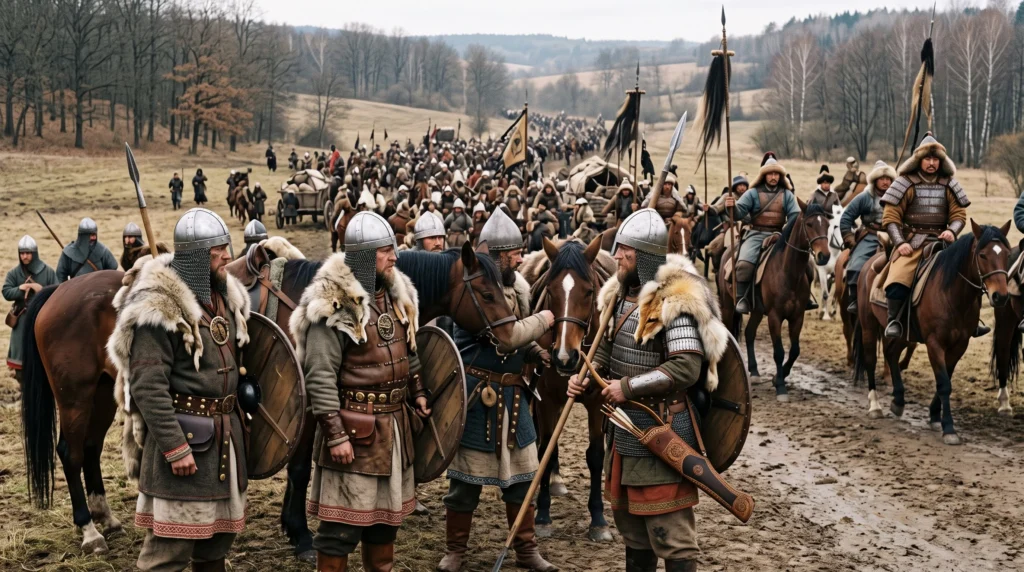
There is a scene in the Mongol advance through Poland in the spring of 1241 that most European histories pass over in silence. On April 9 of that year, Batu Khan’s forces destroyed the combined German and Polish army at the Battle of Legnica, one of the most catastrophic defeats in Central European medieval warfare. Among the forces in the Mongol vanguard were warriors from a Finno-Ugric people called the Mokshas, speakers of an Uralic language from the river systems of what is now the Republic of Mordovia in Russia, some 1,500 kilometers east of where they were fighting. They had not come willingly. Their king, Puresh, appears to have been killed in that very battle. And the night before Legnica, his warriors had been secretly negotiating with the Silesian and German commanders they were about to face, hoping to switch sides and escape the forced vassalage that had carried them across Eurasia.
This moment, brief and violent and ultimately futile, encapsulates the Moksha experience of the Middle Ages: a people caught between larger powers, making whatever calculations survival required, and ending up in places and situations that no one at the center of any empire noticed or recorded.
The World Before the Mongols: Princes, Rivals, and Competing Tributaries
To understand the Moksha position in the 13th century, it helps to understand the political geography of the Middle Volga region in the centuries before the Mongol invasion.
The Mokshas, a Volgaic branch of the Finno-Ugric peoples, occupied river territories centered on the Moksha and Sura rivers, in a region extending roughly from what is now Mordovia westward into areas of modern Penza and Nizhny Novgorod. They were culturally and linguistically distinct from their nearest neighbors and near-relatives, the Erzyas, with whom they have sometimes been grouped under the Russian designation “Mordvins” but whom they regarded as a separate people. The Moksha and Erzya had different political organizations, different tribal confederations, and different, often rival, external alliances.
The Russian chronicles, which provide the earliest written sources on the Mokshas, describe them as living under their own “princes” before the Mongol conquest. The Moksha ruler bore the title of kanazor, a compound of the Moksha word for “prince” and a Turkic element, reflecting the cultural contact between the Finno-Ugric inhabitants and their Turkic neighbors. This title encodes the hybrid political world in which the Mokshas lived: neither fully within the Turkic sphere of Volga Bulgaria to the east nor fully within the Slavic sphere of the Russian principalities to the north and west, but navigating between them.
The primary Erzyan leader of the early 13th century was Purgaz, who commanded a significant tribal confederation and was allied with Volga Bulgaria, the Muslim Turkic state that had been the dominant power on the Volga since the 10th century. Purgaz was an expansionist leader whose territory bordered and sometimes encroached upon both Russian principalities and Moksha lands. The Moksha king Puresh, by contrast, was aligned with the Grand Prince Yuri II of Vladimir, the most powerful Russian ruler of the period.
This alignment was more than diplomatic convenience. In the 1220s, Puresh fought alongside Russian and Cuman forces against Purgaz and his Bulgar allies. In 1230, Purgaz led a force that besieged Nizhny Novgorod, the Russian city built in 1221 at the confluence of the Volga and Oka rivers. The siege failed, and in the aftermath, Puresh’s son Atämaz led Moksha warriors with Cuman allies in a raid deep into Purgaz’s territory, reportedly destroying his stronghold entirely. The intertribal warfare between the Mokshas and the Erzyas was not simply a quarrel between neighbors; it was an extension of the larger geopolitical contest between Volga Bulgaria and the Russian principalities, with the two Mordvinic peoples serving as proxies and occasionally as primary combatants in a struggle neither controlled.
1237: The Mongols Arrive
In the autumn of 1237, the Mongol forces under Batu Khan and the general Subutai crossed the Ural mountains into the territories of the Middle Volga. The Moksha lands were among the first they entered.
The invasion of Moksha territory was swift and overwhelming. The Mokshas had no fortified cities comparable to those of Volga Bulgaria or the Russian principalities; their settlements were scattered along river valleys in a pattern suited to the mixed agriculture, animal husbandry, and hunting that sustained their communities. When the Mongols arrived, resistance was not a realistic option for a population that had no military infrastructure designed to confront steppe cavalry at scale.
Puresh was forced by the Mongol generals Jebe and Subutai to submit and to commit Moksha warriors to the Mongol campaign westward. The precise nature of this compulsion is not fully documented in surviving sources, but the pattern was consistent with Mongol practice elsewhere: tributary peoples were incorporated into the army as auxiliary forces, required to serve in the vanguard positions where casualties were highest and where their deaths did not diminish the Mongol core forces. The Mokshas were not enslaved in the conventional sense, but they were compelled to fight in a war not their own, under commanders not their own, against peoples with whom they had no quarrel.
What is documented is that Moksha warriors participated in the subsequent Mongol campaigns westward. Roger Bacon, writing in his Opus Majus, notes that the Mokshas served in the vanguard of the Mongol army and participated in the capture of Lublin and Zawichost in Poland. Benedict Polone records that the Moksha contingent suffered serious losses in the assault on Sandomierz in February 1241 and in the taking of Krakow in March of that year. By the time the Mongol forces reached Legnica in April, the Mokshas had fought their way across much of central Europe.
Puresh, Narchat, and the Conspiracy at Legnica
The most dramatic episode in Moksha medieval history occurred the night before the Battle of Legnica. According to accounts preserved in the chronicles and later reconstructed from multiple sources, Puresh met secretly with Henry II the Pious, Duke of Silesia, who commanded the allied Polish and German forces. The two apparently reached some form of agreement: the Moksha contingent would switch sides at a critical moment, joining the Silesian and Greater Polish forces against Batu’s army.
Whether this agreement was motivated by loyalty to the Christian powers, by hatred of Mongol servitude, or by some more specific calculation of advantage is not recorded. What is recorded is that the plan failed. Subutai learned of the plot, and on the night of April 8 to 9, Puresh, his son Atämaz, and many Moksha warriors were killed in their camp. The morning’s battle at Legnica proceeded without the intended defection, and Henry II’s forces were destroyed.
Shortly after Legnica, the surviving Moksha soldiers in the Mongol army declared to Batu Khan that they refused to continue fighting against Germans. William of Rubruck, the Franciscan friar sent by King Louis IX of France as an ambassador to the Mongols in the 1250s, later reported that the Mokshas had previously negotiated with the Germans and Bohemians about the possibility of joining their side to escape forced vassalage. Subutai ordered collective punishment: thousands of Mokshas were executed. Approximately a third of the survivors managed to escape and make their way back to their homeland along the Moksha and Sura rivers.
The political aftermath fell to Puresh’s daughter Narchat. She ruled the Moksha ulys (the Mukhsha Ulus under the Golden Horde) initially as regent during her brother Atämaz’s absence and then as queen following the deaths at Legnica. Local legends preserved in the Penza region describe a battle between Narchat and Mongol-Tatar forces, and she is remembered in Moksha oral tradition as a warrior queen who led resistance against the continuing imposition of Horde authority. Historical records suggest she ruled until approximately 1242, when she too was killed in conflict with Mongol forces, possibly drowned in the Moksha River according to local tradition. Her brief reign represents the last moment of autonomous Moksha political authority before the full absorption of Moksha lands into the Golden Horde administrative system.
The Golden Horde: Integration and Resistance
After the deaths of Puresh, Atämaz, and Narchat, the Moksha territories became part of the vast administrative structure of the Golden Horde, the western division of the Mongol Empire ruled by Batu Khan and his successors. The Horde established what scholars call the Mukhsha Ulus on Moksha lands, a regional administrative unit centered at Narovchat (known in sources as Mokshai or Mukhsha), which became a significant settlement with its own trade networks and administrative functions.
The integration into the Golden Horde was not simply a military occupation. It was a transformation of the economic and social organization of Moksha communities. The Horde’s administrative system required regular tribute payments in goods, livestock, and labor. It conducted censuses to assess population and productive capacity. It established outposts that served both as administrative centers and as nodes in the trade networks that connected the Finno-Ugric communities of the forest zone with the steppe nomads of the Golden Horde and, through them, with the wider trade systems reaching from China to the Black Sea.
Archaeological evidence from the Narovchat and Nikolsky settlements indicates that the Moksha region during the Golden Horde period was not simply a zone of exploitation and decline. Agriculture, cattle breeding, and crafts continued to develop. Copper and silver coins were minted. Goods from Old Rus and Central Asia moved along trade routes through the region. The picture that emerges from archaeological study is of communities that maintained their economic vitality even under Horde overlordship, though at the cost of regular tribute extraction that the Grokipedia research estimates at 10 to 20 percent of agricultural production.
Moksha responses to Horde authority were neither simply collaborative nor simply resistant. Tribal leaders made pragmatic calculations: some aligned with Russian principalities like Ryazan or Nizhny Novgorod to counterbalance Horde pressure; others found ways to benefit from their position within the Horde’s trade and administrative networks. The Mukhsha Ulus became a significant exchange hub facilitating commerce between Finno-Ugric forest communities and the steppe nomads of the south, and Moksha elites who managed this exchange could accumulate resources and influence within the system.
William of Rubruck, writing in the 1250s based on his direct observation, referred to the people he encountered in this region as “Moxel,” a transcription of “Moksha” that appears also in the Persian and Arabic chronicle of Rashid al-Din compiled in the early 14th century. These external sources are valuable precisely because they come from observers who had no particular interest in flattening the distinctions among the peoples they encountered: for Rubruck, traveling through the lands of the Golden Horde on a diplomatic mission from the French king, the Mokshas were a distinct people with their own name, territory, and characteristics, worth noting specifically rather than folding into the generic category of “Mongol subjects.”
The Kazan Khanate: A New Overlord
The Golden Horde began to weaken in the late 14th century, fractured by internal succession disputes, devastating raids by Timur (Tamerlane), and the economic disruptions of the Black Death. As central Horde authority collapsed, the regions around the Volga reorganized into successor khanates. The Kazan Khanate, established in the 1430s in roughly the geographic position of the former Volga Bulgaria, became the new overlord of the Moksha territories.
Under the Kazan Khanate, Moksha aristocrats maintained a certain degree of internal autonomy. The khanate’s interest was primarily in tribute and military service, not in transforming the internal governance of tributary peoples. The Moksha nobility continued to manage their own communities, maintain their own customary practices, and negotiate the conditions of their subordination with considerable flexibility.
This period also saw increased pressure from a different direction. Russian expansion had been gradually pushing southward and eastward from the 13th century onward, accelerated after the Golden Horde’s weakening removed the barrier that had previously contained Russian principalities. The Moksha lands lay along the contested frontier between Russian and Kazan Khanate spheres of influence, and Moksha communities found themselves navigating between two expanding powers rather than one.
Russian chronicles from this period document ongoing contact between Russian princes and Moksha leaders, including both conflict and accommodation. Some Moksha communities paid tribute to Russian princes while remaining nominally within the Kazan sphere; others resisted Russian incursion while seeking Kazan protection. The political geography of the Moksha Middle Ages was consistently one of small communities making tactical decisions in an environment dominated by forces they could not control.
1552 and the End of the Medieval Period
The defining political event that ended the medieval period for the Mokshas was the Russian conquest of Kazan in 1552 under Tsar Ivan IV. When Ivan’s forces destroyed the Kazan Khanate, the last political structure that had provided some framework for Moksha autonomy disappeared. The entire Moksha ethnic territory fell under Muscovite control.
The transition was not instantaneous. Russian administration took decades to extend effectively into the forest territories of the Moksha. But the trajectory was clear and irreversible: Moksha lands were gradually allocated to Russian aristocrats and monasteries. Peasants were placed under serfdom. The mobility that had characterized Moksha life, the seasonal patterns of agriculture, hunting, and fishing across river territories with no fixed lord, gave way to the fixed obligations of the Russian agrarian system.
The Mokshas’ animist religious tradition, which had survived the tributes paid to the Muslim Kazan Khanate and the loose suzerainty of the Golden Horde, faced its most serious challenge under Russian rule. Forced baptism of the Mokshas who had “mostly kept their animist religion” took place systematically in the first half of the 18th century, completing the religious transformation that external rulers had not previously attempted in the same coercive manner.
What Remains
The Moksha Middle Ages left physical traces that archaeology has been working to reconstruct. The Narovchat settlement, the administrative center of the Mukhsha Ulus, has yielded material evidence of the community’s economic integration into the Golden Horde trade network: imported goods, minted coins, architectural remains of a settlement that was more than a village. The Nikolsky settlement has contributed similar evidence of material culture continuity despite the political upheaval.
Less tangible but equally significant is what the Moksha experience of the Middle Ages reveals about the position of small Finno-Ugric peoples in the political landscape of medieval Eurasia. The Mokshas were not significant enough to appear in the chronicles of any empire as a primary subject; they appear as tributaries, auxiliaries, obstacles, and occasionally as curiosities worth noting. William of Rubruck mentioned them because he encountered them. Roger Bacon cited them because they appeared in accounts of the Mongol campaigns. They were documented in the moments when they intersected with the concerns of larger powers, not in the texture of their own lives.
What those intersections reveal, when read against the grain of the sources, is a people with their own political traditions (the kanazor title, the role of queens like Narchat), their own internal rivalries (the long conflict with the Erzyas and their Bulgar allies), their own capacity for strategic calculation (the Legnica conspiracy, the opportunistic alliances with Russian principalities), and their own forms of resistance (the refusal to fight against Germans, the flight of survivors back to the homeland).
The episode at Legnica is perhaps the most vivid of these moments: Moksha warriors in a Central European battlefield, their king dead in the night, their conspiracy exposed, thousands executed, and a third walking home across the steppe toward the Moksha River. It is a story that belongs to European medieval history as much as to Russian history or Mongol history, but it appears in none of the standard narratives of any of those traditions. That absence is itself part of the Moksha story of the Middle Ages.
References
- Academia.edu. (n.d.). The Golden Horde and the Penza region.
- Encyclopedia.com. (n.d.). Mordvins.
- Fenno-Ugria. (2024). Moksha.
- Military History Fandom. (n.d.). Puresh.