
The Greek That Never Left: Griko and the Long Survival of an Ancient Language in Southern Italy
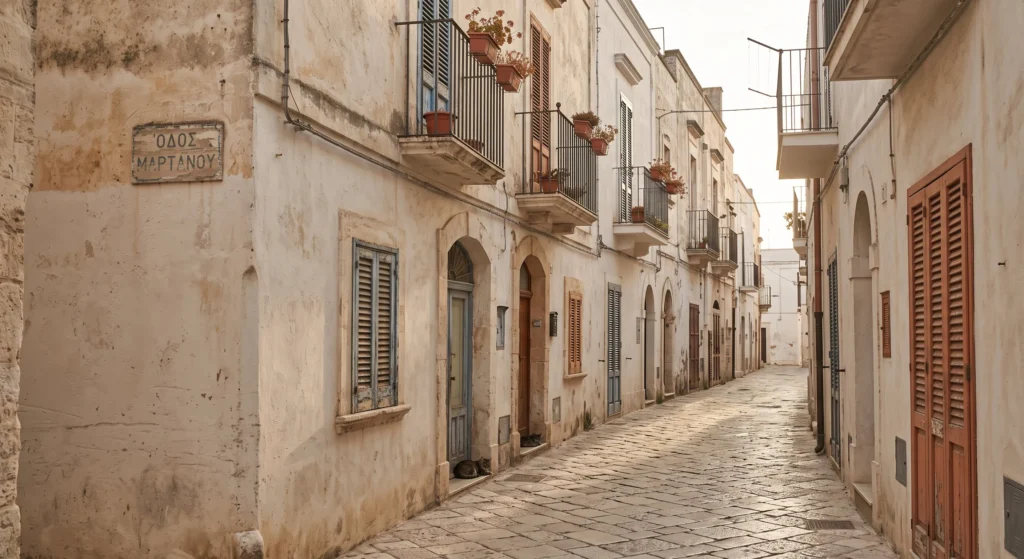
Somewhere in the heel of the Italian boot, in a cluster of small towns southeast of Lecce in the Salento peninsula, there are elderly people who speak a form of Greek. Not modern Greek, learned from a textbook or a television. Not the Greek of Athens or Thessaloniki. A Greek that grew independently from the rest of the Greek-speaking world for somewhere between 1,000 and 2,700 years, absorbing Latin, then southern Italian Romance dialects, then standard Italian, while retaining grammatical structures and words that linguists trace to the ancient colonies of Magna Graecia or to the Byzantine monks who followed.
This language is called Griko, or Grico, or Grecanico in Calabria, where a related variety survives in a handful of mountain villages. It is classified by UNESCO as severely endangered. Its speakers number somewhere between 12,000 and 20,000, and most estimates add that the real figure is likely lower, with fluent speakers concentrated among people over 60. The Griko language survived the fall of Rome, the Arab invasions, the Norman conquest, the Spanish viceroyalty, Italian unification, and the homogenizing cultural forces of 20th-century mass media. Whether it will survive the 21st century is a question that a growing community of activists, musicians, and linguists is working urgently to answer.
Geography: Two Islands of Greek in Southern Italy
Griko is spoken in two geographically and linguistically distinct enclaves that linguists group together under the term Italiot Greek, reflecting their common origin in the Greek colonization of southern Italy.
The larger and better-documented of the two is found in the Grecìa Salentina, a cluster of towns southeast of Lecce in the province of Lecce, Puglia. The nine towns of the Grecìa Salentina, including Calimera, Martano, Sternatia, Zollino, Martignano, Castrignano de’ Greci, Corigliano d’Otranto, Melpignano, and Soleto, form a cohesive cultural zone that has maintained some degree of Greek-language continuity for centuries. The name Calimera, for instance, derives from the Greek kalimera, good morning, an etymological fossil visible to any visitor.
The smaller and geographically more isolated enclave is found in Bovesia (also called the Area Grecanica), a zone of mountainous terrain at the southern tip of Calabria, near Reggio Calabria, centered on villages including Bova, Gallicianò, Condofuri, and Roghudi. The Calabrian variety is sometimes called Greko or Grecanico to distinguish it from the Salentine Griko, and its few hundred fluent speakers are among the most isolated minority-language communities in Western Europe. The terrain that preserved the language, villages perched on the slopes of the Aspromonte massif that were functionally inaccessible for centuries, has also ensured that the speaker base is tiny.
The Origin Debate: Ancient Colonies or Byzantine Monks?
How did Greek come to survive in these pockets of southern Italy when it has disappeared from everywhere else on the peninsula? This question has occupied scholars since at least the 19th century, and the answer remains disputed in ways that matter both linguistically and culturally.
The dominant theory, advanced most influentially by the German linguist Gerhard Rohlfs and supported by the Greek linguist Georgios Hatzidakis, holds that the Griko dialects descend in unbroken line from the Greek spoken by the colonists who settled Magna Graecia beginning in the 8th century BCE. Under this view, Griko is literally ancient Greek that never left, evolved over three millennia in isolation from the rest of the Greek world, shaped by contact with Latin, medieval Romance dialects, and standard Italian, but retaining a core vocabulary and grammatical structure that traces directly to the language of Homer’s contemporaries.
The evidence Rohlfs marshaled included vocabulary items that correspond to ancient Greek words rather than Byzantine Greek words, phonological features like the conservation of geminate consonants that disappeared from standard Greek long ago, and above all the survival of the infinitive, a verbal form that the rest of the Greek world abandoned by the medieval period but which Griko speakers still use in certain syntactic contexts.
The competing theory, favored by Morosi and other Italian linguists, holds that while some Greek presence in southern Italy may be ancient, the modern Griko dialects are primarily descended from the language brought by Byzantine settlers and administrators in the 9th and 10th centuries, when the Byzantine Empire reasserted control over much of southern Italy after repelling Arab incursions. Under this view, the Byzantine layer is the essential foundation, with any older features either preserved from that layer or representing subsequent archaisms.
The controversy generated some of the most cantankerous exchanges in 20th-century Italian linguistics. Rohlfs was vigorously contested by Carlo Battisti and later by Giovanni Alessio; Rohlfs responded in terms that observers described as “unbecoming” in their directness. The debate was taken up by Oronzo Parlangèli in the 1950s, and subsequent scholars have continued to refine the arguments with new linguistic evidence.
The current consensus, to the extent that one exists, favors a layered model: that a Greek-speaking population in southern Italy pre-dated the Byzantine period, possibly continuously from antiquity, but that Byzantine settlement and ecclesiastical activity in the 9th to 11th centuries reinforced and perhaps revived that presence, contributing additional vocabulary and perhaps stabilizing communities that might otherwise have been absorbed into the surrounding Romance-speaking population. The Greek language was dominant across Calabria, Basilicata, Puglia, and eastern Sicily until approximately the 14th century. After that point, the shrinkage of the Greek-speaking zone accelerated under pressure from Latin, Romance dialects, and eventually standard Italian, until only these two enclaves remained.
What the Language Looks Like: Archaisms, Contact Features, and the Infinitive
For linguists, Griko is a resource of unusual value precisely because of its isolation. A language cut off from its relatives for a thousand years or more will preserve features that the rest of the family has discarded, and develop innovations shaped by contact with entirely different languages. Griko does both.
The most discussed feature is the infinitive. Modern Greek lost the infinitive as a productive verbal form by the medieval period, replacing it with subjunctive constructions using the particle na. Standard modern Greek says, roughly, “I want [that] I go” where ancient Greek would have said “I want to go.” Griko retains the infinitive in certain contexts, particularly after modal verbs like “can” and “finish” and in negative imperatives, making it one of the very few modern Greek dialects to preserve this ancient structure. The retention aligns Griko with archaic Greek usage and with some southern Italian Romance dialects that also preserve infinitive constructions, suggesting a reinforcing contact effect between the two language families on this particular feature.
The lexicon is similarly archaic in its core. Much of Griko vocabulary derives from ancient and Hellenistic Koine Greek sources, with archaisms that have disappeared from standard modern Greek but are identifiable by comparison with ancient texts. At the same time, borrowing from southern Italian Romance dialects and standard Italian is extensive, particularly in domains like agriculture, household items, and modern technology. These borrowings have been phonologically and morphologically adapted to Greek patterns, creating a language whose grammar is Greek but whose surface vocabulary is a dense mixture of sources.
Griko is written in the Latin alphabet rather than the Greek alphabet, a feature that distinguishes it from standard modern Greek and reflects centuries of contact with Italian literacy traditions. This has consequences for revitalization efforts: learners who want to read Griko texts must engage with a spelling system that is not the one used for standard Greek, and teachers working with both modern Greek and Griko must navigate between two scripts.
The dialects are only partially mutually intelligible with standard modern Greek. A Greek speaker arriving in Calimera or Gallicianò would recognize enough to establish that the language is Greek-derived, but would find the vocabulary, phonology, and grammatical structures sufficiently divergent to make communication difficult. The divergence is most pronounced in the Calabrian variety, which has retained more archaic features but also absorbed more foreign influence in other respects.
Centuries of Pressure: How the Language Contracted
The history of Griko’s survival is inseparable from the history of its contraction. Greek was once the dominant language across much of southern Italy. The Norman conquest of the 11th century did not immediately destroy Greek-language communities, but it shifted administrative and ecclesiastical power toward Latin, and the cultural prestige of Greek declined accordingly. By the 14th century, the contraction that had been ongoing for two centuries had reduced the Greek-speaking zone to its current pockets.
Within those pockets, Griko survived for centuries as an oral language of rural communities, spoken in villages, in fields, and in households. The contact with Italian increased in the 17th century as bilingualism spread. There were only about twelve villages where Griko was still in common use by the modern period, and even there, Italian became the primary language of education, commerce, government, and aspiration.
The 20th century accelerated the erosion dramatically. The unification of Italy in the 19th century had already imposed standard Italian as the language of the state. But it was the spread of mass media, compulsory education in Italian, and economic migration that did the most damage. Young people from Griko-speaking families moved to northern Italy for work from the 1950s onward, and those who stayed found that speaking Griko in public carried a social stigma. The language was associated with backwardness, poverty, and peasant life. Parents who wanted their children to succeed in the modern world often chose not to pass it on.
The 1971 floods in Calabria destroyed Roghudi and forced its residents to relocate to the coast, scattering one of the last coherent Greko-speaking communities and accelerating the language’s decline in the most isolated part of its remaining territory.
Recognition and Revitalization
The formal legal recognition of Griko speakers as a linguistic minority came in 1999, when the Italian Parliament passed Law 482. The law recognized the Republic’s obligation to protect the language and culture of several minority communities including the Greek-speaking populations of Reggio Calabria and Salento. This was the first time the Italian state had formally acknowledged Griko speakers as a distinct linguistic minority entitled to protection rather than simply as Italians who happened to speak an odd dialect.
The recognition enabled modest institutional support: funding for documentation projects, limited use of Griko in some local schools, cultural events, and radio broadcasts. In the Grecìa Salentina, signage in some towns now appears in both Italian and Griko. The summer school in Calabria where both elderly speakers and young activists gather for an intensive week of language transmission represents a grassroots effort that predates the law but has been sustained partly through funding it enabled.
The challenge, as linguists working on endangered languages recognize, is that formal recognition and institutional support, while necessary, are not sufficient. Languages survive when children learn them at home from their parents. When transmission breaks down at the household level, as it largely has for Griko, institutional programs can slow the decline but rarely reverse it. The speaker most commonly cited in press accounts of Griko, Tito Squillaci, an activist and teacher in Calabria, observed in 2025 that:
“There’s only a few hundred of us left. I’m one of the youngest, and I’m 71 years old.”
This demographic reality is not reversible through school programs alone.
The Music That Kept the Language Alive
If the Griko language has survived into the 21st century with any cultural vitality at all, much of the credit belongs to the tradition of Griko song and to the musicians who have treated that tradition as a living practice rather than a museum piece.
The Salento region has a musical tradition closely associated with the Griko heritage: the pizzica, a driving, rhythmic dance music originally connected to the ritual practice of tarantism, the belief that the bite of a local spider called the taranta required ritual exorcism through music and frenzied dancing. The pizzica tarantata, as the music accompanying this practice is called, is played on large tamburello drums with violin, accordion, and voices, and its 6/8 or 12/8 time signatures create the characteristic momentum that makes it suited to extended trance-like dancing.
By the mid-20th century, both the tarantism practice and its music were dying out. The young people of Salento wanted what they saw on television, not what their grandparents had danced to in barns. It was the writer and activist Rina Durante who changed this trajectory. In 1975, she assembled a group of musicians from the region, including her cousin Daniele Durante as guitarist and bandleader, and vocalists Roberto Licci and Rossella Pinto, naming the ensemble Canzoniere Grecanico Salentino: the Songbook of Greek Salento. The name was itself a declaration. The group’s first concerts were met with hostility; local audiences threw stones because they wanted pop music, not peasant tradition. Rina Durante persisted.
The Canzoniere Grecanico Salentino, now led by Daniele’s son Mauro, has since become Italy’s leading and longest-standing traditional music ensemble, with more than 20 albums, performances at major world music festivals across Europe and North America, and reviews in The New Yorker and National Geographic. Their material includes songs in Griko alongside songs in Salentine Italian, and the group’s name continues to invoke the Greek heritage that the music carries.
The broader revival of pizzica culture in Salento culminated in the Notte della Taranta, a festival founded in 1998 by a handful of Salento towns specifically to keep the tradition alive. What began as a small event has grown into the largest folk festival in Italy. Its culminating concert, the Concertone held in the piazza of Melpignano, a town in the heart of the Grecìa Salentina, draws more than 100,000 people who dance through the night. Each year, a different artistic director, the maestro concertatore, reweaves the old pizzica with orchestras, world music guests, and new arrangements. The festival has made Salento and its Greek heritage internationally visible in a way that no academic documentation project could have achieved.
Other ensembles including Ghetonia and Aramirè have contributed to the Griko musical revival. Greek artists including Dionysis Savvopoulos and Maria Farantouri have performed in Griko, creating connections between the Italian and Greek musical worlds. The ensemble Encardia focuses specifically on Griko songs within the broader musical tradition of southern Italy.
What Is at Stake
The Griko language, whatever its precise origin, is a linguistic document of extraordinary value. It carries within its vocabulary, grammar, and sound patterns a record of how Greek evolved in isolation from the rest of the Greek world over a millennium or more. Archaisms preserved in Griko provide evidence about the history of the Greek language that cannot be recovered from any other source. The retention of the infinitive in particular contexts is a window into a stage of the Greek verbal system that standard modern Greek has left behind. Contact phenomena, the ways Griko borrowed from and influenced the surrounding Romance dialects, illuminate the mechanisms of language contact and code-switching that applied linguistics studies in laboratories and fieldwork sites around the world.
Beyond the linguistic value, the Griko language carries a cultural identity. The communities of the Grecìa Salentina and the Bovesia are not simply Italian communities that happen to speak Greek. They are communities whose sense of themselves includes a connection to a Hellenic heritage that predates the Roman Empire, that survived the Byzantine collapse, and that has endured through pressures that destroyed the Greek-speaking presence everywhere else in the peninsula. That identity is expressed in music, in the names of towns and streets and family recipes, in the oral tradition that Griko songs encode, and in the insistence of elderly speakers and young activists alike that this language deserves to survive.
Whether it will is uncertain. The demographic situation is as unfavorable as any language revitalization specialist would dread. But the music is still playing, the summer schools still fill with students, and the piazza of Melpignano still fills with a hundred thousand dancers on one August night every year. The language that never left has not left yet.